
Applied Anatomy and Clinical Correlations — Flashcards

Musculocutaneous nerve injury commonly occurs in the setting of:- trauma (ex _____ dislocation)- bullet shot to the anterior biceps- strenous upper extremity exercise (ex. baseball pitching)
In the elbow there are three joints, these being:- _____ Joint- Ulnohumeral Joint- Proximal Radioulnar Joint
Injury to the _____ nerve (C8-T1 (nerve roots)) commonly occurs due to:- fracture of the medial epicondyle of humerus "funny bone" (proximal lesion) - fractured hook of hamate (distal lesion) (from fall on outstretched hand - "FOOSH")
The _____ (rotator cuff muscle) is innervated by the axillary nerve.
Before the median nerve enters the wrist / hand within the _____, it travels through the forearm between the flexor digitorum superficialis and the flexor digitorum profundus
Claw hand deficits are _____ pronounced in proximal lesions
Hint: (more/less)
Injury to the _____ nerve (C5-T1) can be caused by- midshaft fracture of the humerus- compression of the axilla- 'nursemaids elbow'- 'finger drop'
The _____ (bone) (palpable in the anatomic snuff box) is the most commonly fractured carpal bone.
_____ bursa continues proximally extending into forearm 2.5cm proximal to flexor retinaculum
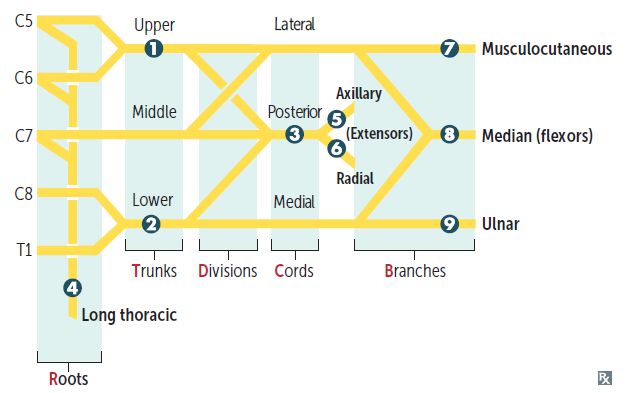
A lesion to the #_____ cord would result in wrist drop, paralysis of the deltoid, and impairment of internal rotation of the humerus
Applied Anatomy and Clinical Correlations Flashcards for NEET-PG
Study 10 flashcards on Applied Anatomy and Clinical Correlations for NEET-PG Anatomy. These active recall cards cover the key concepts, clinical associations, and high-yield facts from this chapter of Upper Limb. Each card is designed to test your understanding rather than just recognition, building stronger and more durable memories for exam day.
For personalised spaced repetition scheduling and unlimited flashcards, download the Oncourse app.
Frequently Asked Questions
Are Applied Anatomy and Clinical Correlations flashcards free?
How many flashcards does this chapter have?
How should I use these flashcards for NEET-PG?
Are there more flashcards for Upper Limb?
Want unlimited flashcards?
Get full access to all flashcards, spaced repetition, and progress tracking.
Start For Free