If there is a lack of Sertoli cells or MIF during development of a genotypically XY fetus, there is _____ internal genitalia and male external genitalia
#2
The trigone on the posterior wall of the urinary bladder is formed by the incorporation of the lower ends of the _____
#3
The male _____ is homologous to the female labia minora, which both arise from the urogenital folds
#4
The embryonic _____ interacts via reciprocal-inductive signaling with the ureteric bud, inducing differentation of these tissues into their respective parts of the kidney
#5
The seminiferous tubules are derived from the _____
#6
_____ stimulates the growth and differentiation of the wolffian ducts, which develop into the male internal genital tract
#7
_____ of the undifferentiated gonad proliferates to form the ovary, and the medulla of the undifferentiated gonad proliferates to form the testis
#8
The _____ bud is derived from the caudal end of the mesonephric duct
#9
Renal agenesis occurs due to failure of the _____ to develop and induce differentiation of metanephric mesenchyme
#10
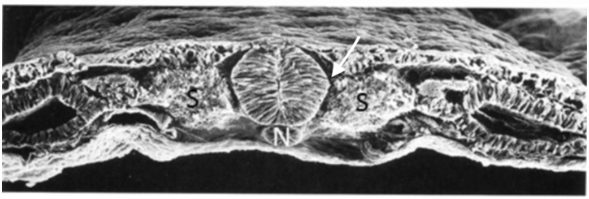
The cells shown in the image are_____ present adjacent to the neural tube (NT)
Development of Urogenital System Indian Medical PG Flashcards - Medical Study Cards
Master Development of Urogenital System with OnCourse flashcards. These spaced repetition flashcards are designed for medical students preparing for NEET PG, USMLE Step 1, USMLE Step 2, MBBS exams, and other medical licensing examinations.
Development of Urogenital System Flashcard Deck - 10 Cards
Flashcard 1: If there is a lack of Sertoli cells or MIF during development of a genotypically XY fetus, there is _____ internal genitalia and male external genitalia
Answer: both male and female
Flashcard 2: The trigone on the posterior wall of the urinary bladder is formed by the incorporation of the lower ends of the _____
Answer: mesonephric ducts.
Flashcard 3: The male _____ is homologous to the female labia minora, which both arise from the urogenital folds
Answer: ventral shaft of penis (penile urethra)
Flashcard 4: The embryonic _____ interacts via reciprocal-inductive signaling with the ureteric bud, inducing differentation of these tissues into their respective parts of the kidney
Answer: metanephric mesenchyme
Flashcard 5: The seminiferous tubules are derived from the _____
Answer: sex cords
Flashcard 6: _____ stimulates the growth and differentiation of the wolffian ducts, which develop into the male internal genital tract
Answer: Testosterone
Flashcard 7: _____ of the undifferentiated gonad proliferates to form the ovary, and the medulla of the undifferentiated gonad proliferates to form the testis
Answer: Cortex
Flashcard 8: The _____ bud is derived from the caudal end of the mesonephric duct
Answer: ureteric
Flashcard 9: Renal agenesis occurs due to failure of the _____ to develop and induce differentiation of metanephric mesenchyme
Answer: ureteric buds
Flashcard 10: The cells shown in the image are_____ present adjacent to the neural tube (NT)
Answer: neural crest cells (NCC)
Keywords: Development of Urogenital System flashcards, medical flashcards, NEET PG preparation, USMLE Step 1 flashcards, Anki alternative, spaced repetition medical, OnCourse flashcards
Development of Urogenital System Flashcards for NEET-PG
Study 10 flashcards on Development of Urogenital System for NEET-PG Anatomy. These active recall cards cover the key concepts, clinical associations, and high-yield facts from this chapter of Embryology and Development. Each card is designed to test your understanding rather than just recognition, building stronger and more durable memories for exam day.
For personalised spaced repetition scheduling and unlimited flashcards, download the Oncourse app.
Frequently Asked Questions
Are Development of Urogenital System flashcards free?
Yes, all flashcards on this page are completely free. You can study all 10 cards at no cost. For spaced repetition scheduling, download the Oncourse app.
How many flashcards does this chapter have?
There are 10 flashcards for Development of Urogenital System, covering the key concepts, clinical correlations, and high-yield facts from this chapter of Embryology and Development.
How should I use these flashcards for NEET-PG?
Read through each prompt and try to answer before revealing the back of the card. This active recall approach builds stronger memories than passive reading. Combine flashcards with the study notes and MCQ practice for the best results.
Are there more flashcards for Embryology and Development?
Yes. This page covers one chapter of Embryology and Development. Visit the topic page to see all chapters and their flashcards under Anatomy.
Want unlimited flashcards?
Get full access to all flashcards, spaced repetition, and progress tracking.
